
DACHAU CONCENTRATION CAMP HISTORY
About Dachau Concentration Camp
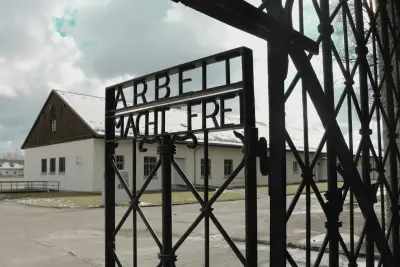
Dachau concentration camp was established in March 1933 in Germany, near Munich. It was the first Nazi concentration camp and served as a model for others. Initially, it held political prisoners, but during World War II it also imprisoned Jews, Roma, homosexuals, Jehovah’s Witnesses, clergy, and others. Prisoners faced forced labor, starvation, medical experiments, and brutal treatment. More than 200,000 people were imprisoned there between 1933 and 1945, and around 41,500 prisoners died. The camp was liberated by U.S. forces on April 29, 1945. Today, Dachau is preserved as a memorial site, honoring the victims and educating visitors about the crimes committed there.

Model for all Nazi camps
Dachau became a strong symbol of the Nazi concentration camp system. It set the rules and structure that other camps copied. The SS trained many guards there who went on to run camps across Nazi-controlled Europe. Dachau stayed open from March 1933 until April 1945. Its long history shows how Nazi policies changed and grew over time.

Victims of Dachau
From 1933 to 1945, more than 200,000 people were imprisoned at Dachau. These included political opponents like Communists and Social Democrats, as well as Jews, Roma, homosexuals, Jehovah’s Witnesses, clergy, and people from many occupied countries. Historians estimate that about 41,500 died in Dachau and its subcamps during its operation. Many deaths were caused by forced labor, starvation, disease such as typhus, brutal treatment, or execution. The toll also includes thousands whose deaths were never fully recorded, such as those killed during death marches near the end of the war.

Cruelty and suffering in Dachau
The camp also became a training base. SS guards learned their cruel methods here and then carried them out in camps across Nazi Europe. Prisoners lived in constant fear: beaten for tiny mistakes, packed into small cells, forced to stand for hours, or tortured with punishments like tree-hangings. Doctors performed deadly experiments, testing how long people could survive in icy water, exposing them to low air pressure like high-altitude conditions, or making seawater drinkable. Many died or were left with permanent injuries.

Religious persecution
Dachau was a major site for the imprisonment of clergy, especially Catholic priests who opposed the Nazi regime. More than 2,700 clergy were held there, the vast majority from Poland. Many endured the same harsh conditions as other prisoners, while others were singled out for special abuse. Despite the risks, secret religious services and acts of spiritual resistance still took place.

Subcamps and forced labor
Dachau controlled a network of more than 140 subcamps across southern Germany and Austria. Many prisoners were sent directly to these sites to work in armaments production, construction, and other war industries. Conditions in the subcamps were often even worse than in the main camp, with very little food, almost no medical care, and constant abuse from guards.

After the war
After its liberation in April 1945, Dachau was used by U.S. forces to hold SS members and Nazi officials awaiting trial. Later, it became a temporary shelter for German refugees expelled from Eastern Europe. In 1965, after years of effort by survivor groups, Dachau was officially opened as a memorial site. Today, it stands as a place of remembrance and a warning against the dangers of hatred and dictatorship.
A history the world must never forget
The history of Dachau tells the story of the Nazi regime from its earliest days to its defeat. It shows how a site built for political prisoners grew into a vast system marked by cruelty, fear, and death. Today, Dachau remains a powerful reminder of what can happen when prejudice, violence, and dictatorship go unchallenged. We highly recommend joining one of our Dachau Tours to gain deeper insight into its history and the experiences of those who were imprisoned there.
Learn more about the Dachau and its tragic history with our guided tours

Personalized experience
Dachau Private Tour
Experience the gravity of Germany’s first Nazi concentration camp. On this Dachau Private Tour, a guide will lead you through the barracks, the cells, and more. As you walk, your private guide will teach you about the site’s tragic history. Learn about prisoners’ daily life, medical experimentation, and the camp’s final liberation. With a tour guide devoted to your group, ask as many questions as you like and visit what interests you most.

Licensed guide
Dachau Tour from Munich
Witness the gravity of the first concentration camp with the Dachau Tour from Munich. First, meet your guide in Munich and take the train together. Travel through the countryside to Dachau. Explore the Dachau camp's memorial site, and see the former cells, barracks, and more. As you walk, your guide will teach you the sobering history of Dachau. End the tour at the Dachau Memorial Museum, and view historical documents and photographs.